
 Talent Atscale

 Our expertises
B2B Sales Training
Hands-on training for sales reps and sales managers, delivered by battle-tested sales leaders.

Atscale delivers tailored B2B sales training for growing tech companies: in-house programs for a whole sales team, or open-enrolment sessions for one or two people. Every program is built and delivered by former VP Sales, CROs and top performers, and every workshop runs on your live deals.
Great sales training shows up on live calls next week, not on feedback forms. Zero generic cases: only your active pipeline, real-world objections, and manager coaching ready for next Monday.
IMMEDIATE IMPACT
Practical application on live deals, real objections, and upcoming 1-on-1s.
-
What is sales training?
Sales training focuses on coaching a sales team through deliberate practice: simulations, role-playing, call reviews, and feedback. It turns learned methodology into consistent behaviors in front of prospects. While traditional sales training delivers knowledge, practical sales training drills it until it holds up under the pressure of a live meeting.
At Atscale, sales training is judged by what changes in the team's meetings the following week. Our programs use zero generic case studies: they focus directly on your live pipeline, the objections your reps hear every day, and the coaching rituals your managers need.
Two formats:
in-house and multi-company
In-house sales training
The program is dedicated to a single company and built around its specific sales organization. It kicks off with an in-depth diagnosis: listening to your recorded calls, analyzing your pipeline, and reviewing your sales collateral. This is the highest-impact format, as it trains both managers and sales reps within the exact same framework.
Open-enrollment sales training
Sessions bring together sales reps from different, non-competing companies. This format is ideal for training one or two people, or a newly promoted manager. Each participant brings their own real accounts, and Atscale ensures at registration that all attendees sell complex B2B solutions with comparable sales cycles.
Who our B2B sales training is for?
Sales managers
Frontline managers anchor new habits, review calls, and maintain execution standards. A common scenario: your top-performing Account Executive was promoted to manager based on individual results, without any management methodology. They keep closing deals for their reps, and their pipeline reviews turn into mere inventories. The training focuses on concrete rituals, using the team's live pipeline as the training ground.
Sales reps
Sales reps make up the majority of participants, across both inside sales and field sales. The training covers discovery, qualification, value selling, objection handling, negotiation, and closing, as well as prospecting for SDRs. Run alongside the managers' track, it establishes a shared vocabulary and common qualification criteria.
B2B sales training modules
Program content is tailored to the findings of the initial diagnostic. These are the main modules covered in our B2B sales training programs:
| Module | Target Audience | Key Focus & Deliverables |
|---|---|---|
| Sales Management | Sales Managers | Setting credible targets, running deal-driving pipeline reviews and action-oriented 1-on-1s, giving constructive feedback, leading high-impact weekly meetings. |
| Sales Methodology | Managers & ICs | Adapting MEDDIC, MEDDPICC, Challenger Sale or SPIN to your sales cycle: qualification, champion building, early identification of dead deals. |
| Coaching & Call Analysis | Managers & ICs | Deconstructing live calls (discovery, demo, negotiation) and giving managers structured frameworks to run call coaching on their own. |
| Objection handling, negotiation and closing | Account Executives | Dissecting real customer objections (pricing, competitors, status quo), roleplaying scenarios, documenting response playbooks. |
| Outbound prospecting | SDRs | Targeting, first-call openers and booking discovery meetings, worked on your own target accounts. |
| Sales Performance & Analytics | Sales Managers | Building actionable dashboards, spotting stage-by-stage drop-offs, diagnosing individual underperformance. |
| Territory & Account Planning | Sales Managers | Segmenting account portfolios and prioritizing high-value target accounts when flagged by the diagnostic. |
 Sales training drills built on your own deals
Sales training means practice: role-plays, call reviews and feedback, repeated until the method holds in a real meeting. Every drill starts from material your team produced that week.
- Live deal role-play. The rep prepares their next meeting, plays it against a trainer acting as the buyer, then replays it after the debrief.
- Recorded call review. A discovery or negotiation call from the week is reviewed as a group, then the manager applies the coaching grid to the next call.
- Price or status quo objection. Objections heard that same week are played out, and the answers that work go into the team's objection playbook.
- Opportunity qualification. A deal from the pipeline is run through the chosen methodology to decide whether to accelerate it or drop it.
- Territory planning workshop. Managers segment their real portfolio and choose the accounts to prioritise.
Practice examples using your own deals
Every exercise is built around real material from your team.
Participants walk away with finished deliverables: an objection playbook, shared qualification criteria, one-on-one meeting templates, and team performance dashboards.
Role-playing on an active deal
The rep prepares for their upcoming meeting, runs through it with a trainer acting as the buyer, and replays it after the debrief.
Recorded call review
A discovery or negotiation call from the current week is reviewed as a group, followed by the manager applying the coaching scorecard to the next call.
Price or status quo objections
Objections encountered during the week are role-played, and high-converting responses are added directly to the team's objection playbook.
Opportunity qualification
A deal from the live pipeline is screened against the chosen methodology to decide whether to accelerate it or walk away.
Territory planning workshop
Managers segment their actual book of business and prioritize target accounts.
Why most sales training programs fade
Most programs lose their effect for the same reasons. Ours is built to avoid each of them.
| Why it fades | How Atscale handles it |
|---|---|
| Generic case studies, far from the team's sales cycle | Workshops built on your deals, your calls and your objections |
| A manager trained alone, back to a team with unchanged standards | Managers and reps trained within the same framework |
| Sessions packed into consecutive days, with no practice in between | Sessions spaced out so the team applies each workshop before the next |
| No follow-up after the last session | Follow-up sessions included in every program |
| Success measured with satisfaction surveys | Sales metrics measured before and after the program |
 A diagnostic before the first workshop
For in-house programs, the process begins with interviews across leadership and sales reps, reviews of recorded calls, pipeline quality analysis in your CRM, and an audit of your collateral (value proposition, battle cards, market studies, sales playbook). This process pinpoints the root causes of underperformance, which often differ from initial assumptions, and presents them to you before finalizing the training curriculum.
Measuring the impact on your sales metrics
Prior to launch, Atscale benchmarks your baseline: pipeline generated per rep, stage-by-stage conversion rates, average deal size, sales cycle length, quota attainment, and ramp-up time for new hires. The exact same metrics are measured after the program to quantify its impact.
This measurement relies on actionable CRM data. When data quality is lacking, cleaning up pipeline tracking comes first, backed by Atscale's Revenue Operations expertise.
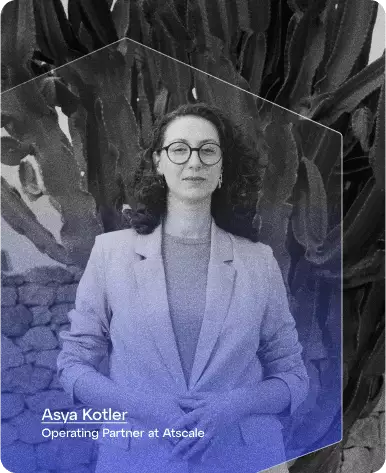
Sales training delivered by former sales leaders
We don't just teach theory. We bring real-world experience into every training session, so your team gets practical, proven techniques that work in the field.
Our B2B sales training programs are built and delivered by seasoned sales leaders who have spent 15 to 25 years selling, leading and scaling commercial teams, many at companies that went public or were acquired.
We've run thousands of discovery calls, closed seven-figure deals, coached underperformers into top reps, and rebuilt teams from the ground up. We know what works, and what doesn't.

Built to drive pipeline and close deals
This isn’t checkbox training. We design every program to move the metrics that matter: pipeline generated, win rate, deal size and quota attainment. Your team walks away sharper, more confident, and ready to perform.


“Thanks to our collaboration we have succeeded in raising our fund, in the sense that we have had a commercial plan to achieve our goals”

Louis Coulon
Co-Founder of CleverConnect
Additional services
Frequently asked questions about sales training
Who provides tailored B2B sales training?
Atscale's custom sales training relies on zero generic case studies: we work directly on your active deals, the actual objections your reps hear daily and the 1-on-1 coaching frameworks your managers need. Programs are built and delivered by seasoned sales leaders who have spent 15 to 25 years selling, leading and scaling commercial teams, many at companies that went public or were acquired. Two formats are available: in-house, fully dedicated to one company and built on a thorough diagnostic, or multi-company sessions grouping professionals from non-competing companies that sell complex B2B solutions.
How is your approach different from a conventional training provider?
On two counts. First, the people delivering it: our sessions are led by former VP Sales and CROs from B2B tech with 15 to 25 years in the field, and by seasoned ICs whose top performer track record is verifiable. Not by professional trainers. Second, the content: we do not run a catalogue programme with adapted examples, we build the workshops from real calls, real objections and real pipelines. A participant leaves with work done on their own accounts, not with a course pack.
Should we choose in-house or open-enrolment?
It depends on how many people you need to train and how deep you want to go. In-house makes sense as soon as a whole team is involved: the programme is dedicated, it is built on a full upfront diagnosis and it allows managers and reps to be handled together, which is the best guarantee that the practices will hold. Open-enrolment works for one or two people, in particular a newly appointed manager, or when you want to test our approach before committing the whole team. In both cases, every participant works on their own deals.
What do you ask of the company before the training?
For in-house programmes, four things. Interviews with the manager and their team, to understand the situation from the inside. Access to a series of recorded calls, the most valuable element and the most often overlooked. Read access to the pipeline in your CRM. And your sales and marketing materials: value proposition, battle cards, market research, sales playbook. This preparation takes a few hours on your side and determines how relevant the whole programme will be. For open-enrolment sessions, we simply ask each participant to arrive with two or three live deals they want to work on.
What topics can you cover?
For managers: performance management, running one-to-ones and pipeline reviews, coaching frameworks, team rituals. For ICs: discovery and qualification, value selling, objection handling, negotiation and closing, outbound for SDRs. For both populations: sales methodology, with MEDDIC, MEDDPICC, Challenger Sale or SPIN depending on your context. The exact scope is defined after the diagnosis, based on what it reveals. Sometimes the topic that needs addressing is not the one flagged at the outset.
Which sales methodology do you train on?
On the established B2B frameworks: MEDDIC and MEDDPICC for qualification and champion identification, Challenger Sale for building value and taking control of the conversation, SPIN Selling for the structure of discovery. We do not apply them to the letter: we keep what fits your sales cycle and your market, then install it as a shared language across the team. A methodology that is not shared by everyone is useless.
Do you train managers and reps separately?
Both are possible, but we recommend combining them in-house. A manager trained on their own returns to a team whose vocabulary and standards have not changed, and falls back into old habits. Conversely, trained ICs whose manager cannot sustain the new practices lose what they gained just as fast. In a full programme, we train both populations in alternation, with joint sessions on the points where they connect.
How do you make sales training scale beyond the workshops?
By making managers the relay. In-house training allows managers and reps to be trained within the same framework, so new sales behaviors become permanently embedded across the organization. We set up a coaching framework that managers then run on their own, and participants leave with finished work product: a documented objection playbook, standardized qualification criteria, 1-on-1 templates and actionable team dashboards.
How does sales training improve win rate?
Win rate is one of the metrics every program is designed to move, along with pipeline generated, deal size and quota attainment. The sales methodology module works on qualification, champion building and early identification of dead deals, and the objections, negotiation and closing module dissects real customer objections on pricing, competitors and status quo. Before launch, we benchmark your team's stage-by-stage win rate, then measure it again after the program to quantify the operational impact.
When do the results show?
Effects on behaviour come first, provided a follow-up session is scheduled: that is where the drop-off happens. Effects on sales metrics come next, depending on the length of your sales cycle, since you need at least one full cycle to see movement on win rate. Continuous improvement and practice remain necessary to get the most out of it over time.
What happens after the training?
We always recommend at least one follow-up session, because it is in the weeks following a workshop that most of what was worked on gets lost. That session is there to revisit the real situations encountered in the meantime, correct what has been misapplied and consolidate what is working. The deliverables produced during the programme, objection library, qualification criteria, one-to-one templates, stay with you and serve as a reference for your next joiners.
Explore more
Let’s have a conversation
We value the opportunity to connect with you. Please don’t hesitate to request a call—our team is available to discuss how we can best support you.